.jpg)

Brain-computer interfaces (BCIs) are unlocking new possibilities in healthcare and human interaction, from restoring mobility and enhancing senses to seamlessly controlling devices through neural biofeedback. These innovations, built on a century of neuroscience, trace back to Hans Berger’s 1924 discovery of brain electrical activity via electroencephalography (EEG) and Eberhard Fetz’s 1969 breakthrough showing how monkeys could control neuronal activity through biofeedback.
These foundational efforts underscore the essence of modern BCIs, which capture, interpret and act upon neural signals to achieve therapeutic and assistive goals. By tracing the trajectory from early EEG experiments to cutting-edge implants, we can see BCIs' remarkable transition from experimental labs to approved clinical therapies that redefine what is possible in healthcare and beyond.
Modern Innovations in BCIs
BCIs have come a long way since their early beginnings, with new generations of devices now addressing a range of critical needs—from restoring lost functions to enhancing human capabilities. For instance, Blackrock Neurotech’s MoveAgain BCI, recognized as a Breakthrough Device by the FDA in 2021, has given individuals with paralysis a new level of autonomy by using neural commands to operate digital interfaces and assistive devices.
Similarly, Neuralink’s high-resolution implant, building on its 2023 FDA approval for human trials, aims to restore vision and mobility by capturing neural signals with unprecedented precision. These advancements dismantle barriers for individuals with severe disabilities, translating neural activity into improved communication, mobility, and independence.
Expanding Applications of BCIs
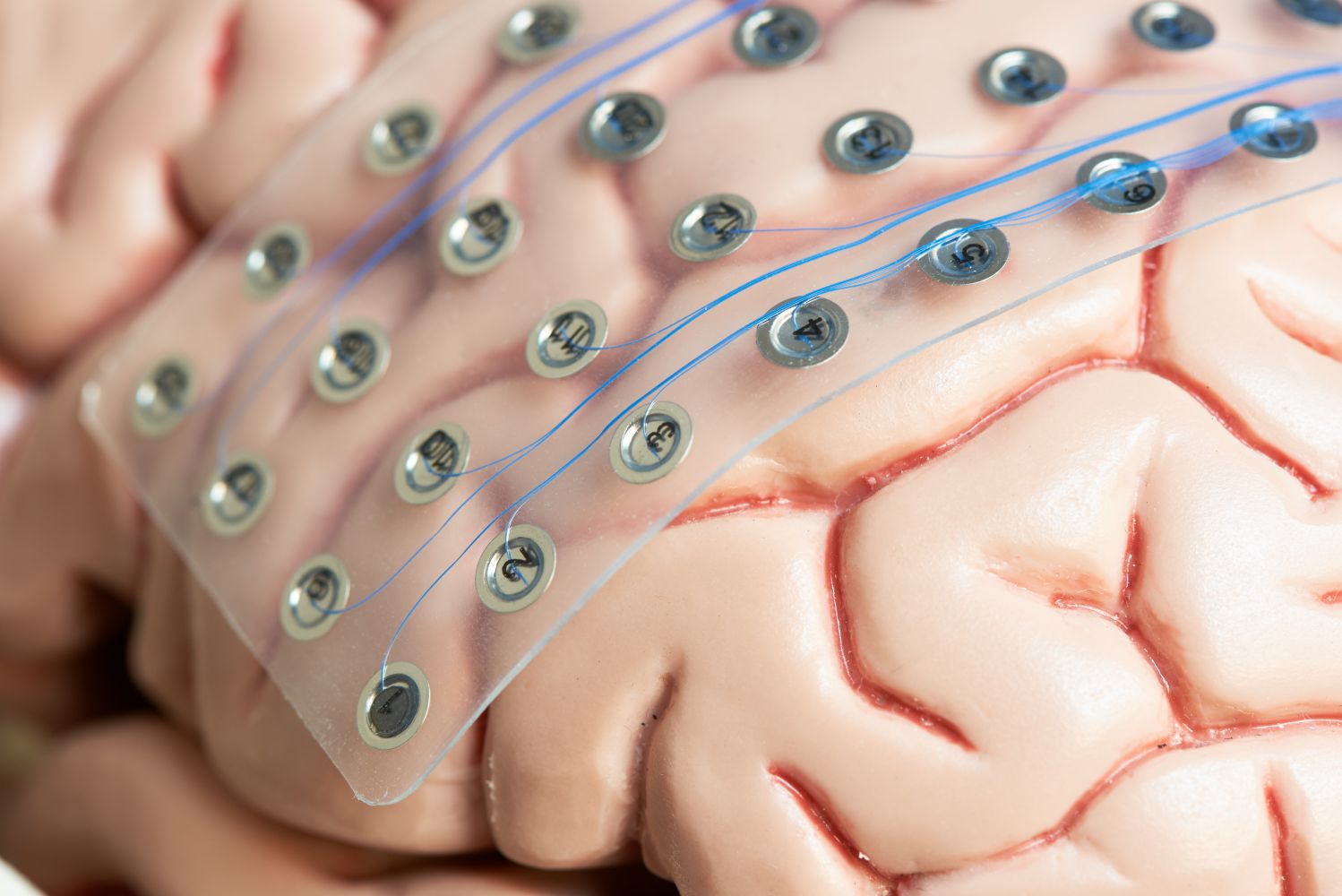
A robust pipeline of experimental BCIs is addressing neurological challenges with innovative, less invasive solutions. Synchron’s Stentrode, positioned within cortical blood vessels instead of on the brain surface, allows patients with paralysis to operate digital devices through thought alone. Another visionary concept, Neural Dust, uses miniature, ultrasound-powered sensors to enable long-term neural monitoring and therapy without bulky implants. Additionally, Precision Neuroscience’s Layer 7 Cortical Interface offers high-resolution mapping with minimal surgical risk, balancing clarity and safety. These designs—stentrodes, thin-film arrays, and MEMS sensors—showcase diverse approaches driving next-generation neurotechnology.
Bridging Applications to System Design
Developers of BCIs must balance technical feasibility with clinical realities. For instance, thin-film arrays offer excellent resolution but demand materials resistant to bodily fluids, while less invasive stentrodes may sacrifice signal fidelity. In addition, traditional invasive systems like the Utah Array provide precision but struggle with long-term biocompatibility.
Matching BCI designs to specific needs is critical—intracortical arrays suit precise motor control for robotic arms, while minimally invasive stentrodes are ideal for communication. This alignment of features with clinical demands drives research, prototyping, and clinical trials, shaping BCIs to meet diverse therapeutic objectives.
Signal Acquisition
At the heart of these advancements lies the foundational process of signal acquisition—the ability to capture and interpret neuronal electrical signals. This process underpins the functionality of all BCIs, influencing their effectiveness and applications. Signal acquisition is achieved through approaches ranging from non-invasive EEG to fully invasive intracortical microelectrodes.
As a middle ground, minimally invasive techniques like electrocorticography (ECoG), Stentrode™ arrays, and stereo-EEG (sEEG) electrodes, balance signal quality, spatial resolution, and patient safety. Although non-invasive systems are safer, they often provide lower-resolution data. In contrast, fully invasive arrays yield high fidelity, localized signals but involve greater surgical complexity and durability concerns. Matching signal fidelity with invasiveness remains a key consideration in sensor design.
Across all these categories, material selection for BCI electrodes is paramount, with titanium or platinum-iridium alloys offering corrosion resistance and signal integrity. However, coatings or treatments are often needed to deter fibrotic tissue growth and oxidation. Increasing the number of sensors in BCIs promises finer neural recordings and enhanced control of prosthetics but introduces challenges. For instance, adding more sensors complicates wiring, feed-throughs, and sealing, making hermetically sealed, high-channel systems a significant hurdle for reliable manufacturing and clinical adoption.
Moreover, researchers debate whether expanding sensor counts yields proportional benefits. While higher resolution may enhance data capture, the associated risks—like mechanical failure, surgical complications, and interference—must be weighed. The goal is to find the “sweet spot” where BCIs capture enough neural information to improve outcomes without compromising safety and reliability. The diversity of sensor technologies underscores the complexity of signal acquisition, driving innovation in materials, coatings, feed-throughs, and surgical approaches. Ultimately, balancing channel count with long-term performance will be key to ensuring BCIs effectively meet the needs of patients and practitioners.
Lead Transmission and Connector Interfaces
In most BCI designs, leads carry neural signals from electrodes to a processing unit, with thin-film and multi-lumen leads favored for their flexibility and signal quality. For high-density, invasive systems, this design becomes even more important. Multi-lumen leads, in particular, enable complex recordings by supporting multiple data channels, but increased sensors heighten risks of mechanical wear and signal degradation.
To maintain performance, connector interfaces such as feed-throughs and lid-throughs must protect electronics from fluids while maintaining data clarity. Achieving this balance often relies on hermetic sealing, however, integrating hundreds or even thousands of channels into a single interface can strain both materials and manufacturing.
Research is exploring several strategies to address scaling issues in BCIs. One approach stacks feed-through arrays to fit more channels in a compact footprint while preserving hermeticity. Another reduces the number of wires by incorporating on-board or near-electrode signal processing. Flexible polymer-based interposers are also being investigated to further miniaturize the signal routing. These techniques balance the need for high-resolution neural data with the goal of ensuring implant longevity and reliability, an ongoing area of innovation in the BCI field.
On-Board Signal Processing and Data Compression
Neural signals, typically in the microvolt range or below, are prone to noise and interference, requiring amplification with low-noise amplifiers to preserve signal integrity. After amplification, filtering algorithms remove baseline drift, movement-induced artifacts, or other sources of noise. In real-world environments, variability in electrode placement and tissue conditions complicate signal acquisition, making dynamic filtering strategies essential.
As BCIs scale, data compression becomes crucial to reduce the load on wireless channels and conserve battery power, using techniques like down sampling or neural network–based encoders. Power and thermal management are also critical as excessive heat or power consumption can damage tissue, or reduce an implant’s operating life, necessitating energy-efficient processors to maintain safety and longevity.
Looking ahead, researchers are exploring neuromorphic hardware inspired by the brain’s structure to process neural data more efficiently than conventional microcontrollers. These chips could enable more complex real-time analysis within the power and thermal limits of an implant. As these technologies evolve, on-board signal processing will play a pivotal role, converting raw neuronal signals into digital data that drives meaningful outputs in the real world.
Wireless Telemetry for Transmission and Reception
After signals are pre-processed and compressed, they are wirelessly transmitted to an external receiver using protocols tailored to specific system needs like Medical Implant Communication Service (MICS) and Bluetooth Low Energy (BLE). MICS is designed to minimize interference, making it ideal for traditional neurostimulators that require low-bandwidth data transmission.
On the other hand, BLE can handle moderate data rates, and with optimized antenna design and power output, offers reliable short-range performance. Ultimately, the choice of telemetry protocol comes down to balancing data demands, energy efficiency, and interference resilience, evolving as systems demand more, real-time control.
Data Extraction and Processing
As a next step, once neural signals are collected by an external device, they are analyzed to convert raw brain activity into practical outputs, such as controlling a prosthetic limb or delivering precisely timed electrical impulses to address symptoms of epilepsy or Parkinson’s disease. At the heart of these systems are computational methods designed to detect subtle patterns in neural data.
For instance, machine learning algorithms—including neural networks and hidden Markov models—excel at detecting patterns in neural data, even amidst background noise. This can be seen when patients imagine moving their arms. Specific motor cortex signals can be identified and translated into commands for a robotic arm within milliseconds, enabling near-instant feedback.
Adaptive Control and Continuous Feedback
Once real-time data is processed, BCIs take the transformative step of converting decoded signals into actions while adapting to the users' changing neural patterns. Modern systems not only read brain activity but also engage in a continuous feedback loop, adjusting decoding parameters and providing sensory feedback for fine-tuning commands. This is critical for tasks like controlling robotic limbs or adjusting neural stimulation in conditions like epilepsy or Parkinson’s disease. Over time, training methods such as haptic cues or gamified neurofeedback help users improve confidence and precision. As electrode counts increase and machine learning advances, systems become more adaptable, offering smoother, more intuitive experiences.
Bridging Thought and Action
As the advancements in BCI technology continue to accelerate, the field is making significant strides toward realizing the vision sparked by early EEG experiments that demonstrated the brain’s ability to generate electrical signals for control. Today’s neural interfaces unite miniaturized sensors, high-density leads, wireless telemetry, and adaptive intelligence to restore lost functions and enhance human capabilities. By integrating clinical innovation, materials engineering, real-time data analysis, and user-centered design, researchers are advancing these technologies beyond the laboratory and into everyday life, redefining what is possible in healthcare and bridging the gap between thought and action.
Written by: Kirk Gronda and Brad Womble